

Broadband Characterization of Polarization Mode Dispersion for Quantum Communication Channels
Invited Talk
V Rodimin1, Y Kurochkin1, K Kravtsov1, R-M Chua1, X Zhang1,2, A Ponasenko1, J A Grieve1
1 Quantum communications, TII, Abu Dhabi, United Arab Emirates
2 Centre for Quantum Technologies, National University of Singapore, Singapore, Singapore
Seminar: S1 — Modern Trends in Laser Physics
Monday, 6 July 2026 · 15:05 – 15:30
Abstract
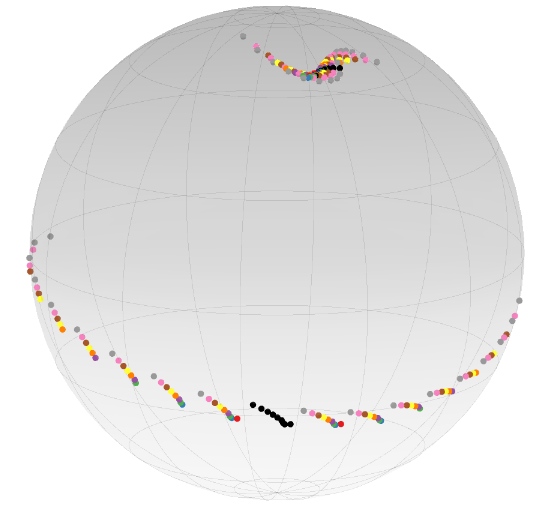
Fig. 1. Points of the same color correspond to the same filtering bandwidth $\Delta\lambda$. For each bandwidth, the method identifies the most compact and the most extended trajectories on the Poincare sphere and determines the measurement-basis vectors (black points) that minimize the projection error
Broadband quantum communication systems are especially sensitive to polarization mode dispersion (PMD), since wavelength-dependent polarization transformations in deployed fibers lead to projection errors and increased quantum bit error rate. The broadband SPDC sources are attractive for their brightness and narrowing the optical spectrum reduces the useful photon flux [1].
Standard telecom PMD measurement techniques can access wavelength-dependent polarization information [2]. However, their conventional use in fiber specifications and system design is typically limited to DGD-based metrics. These quantities are well suited for classical telecom impairment estimates, but they do not directly specify the influence of higher-order PMD, or the measurement-basis dependence of projection errors. Therefore, for broadband quantum signals, DGD alone is not a sufficient channel descriptor.
Here we present a trajectory-based methodology Fig. 1 for broadband PMD characterization in quantum communication channels. For a given input state, the output polarization forms a trajectory $\mathbf{s}(\lambda)$ over the spectral interval of interest. The projection error for a measurement basis vector $\mathbf{e}$ is evaluated by numerical trajectory integration,
\begin{equation} p_e = 1 - \frac{1}{\Delta \lambda} \int_{\Delta \lambda} \left|\langle s(\lambda)|e\rangle\right|^2 d\lambda , \end{equation}
which gives the channel-induced infidelity relevant for broadband quantum measurements.
We apply this method to wavelength-resolved polarization measurements in deployed telecom fiber links. Our analysis reveals that higher-order PMD can noticeably modify infidelity compared with a DGD-only description. As a practical output, we propose to characterize a broadband quantum channel by the spectral bandwidth that produces a chosen infidelity threshold around a reference wavelength, together with conventional DGD information. The same framework can also guide PMD-aware basis selection and compensation strategies.
References
- V Rodimin, K Kravtsov, R M. Chua, et al., Phys. Rev. A 112, 032620 (2025); DOI: 10.1103/l2l7-b98w
- IEC 60793-1-48:2017, ''Optical fibres – Part 1-48: Measurement methods and test procedures – Polarization mode dispersion,'' International Electrotechnical Commission, 2017