

Improving THz Radiation Power in Realistic Multi-Quantum Well Devices
G Klimeck1, I Okhmatovskii1, A Toro1
1 School of Electrical and Computer Engineering, Birck Nanotechnology Center and Purdue Quantum Science and Engineering Institute, Purdue University, West Lafayette IN, USA
Seminar: S10 — Quantum Engineering and Biophotonics
Monday, 6 July 2026 · 15:00 – 15:30
Abstract
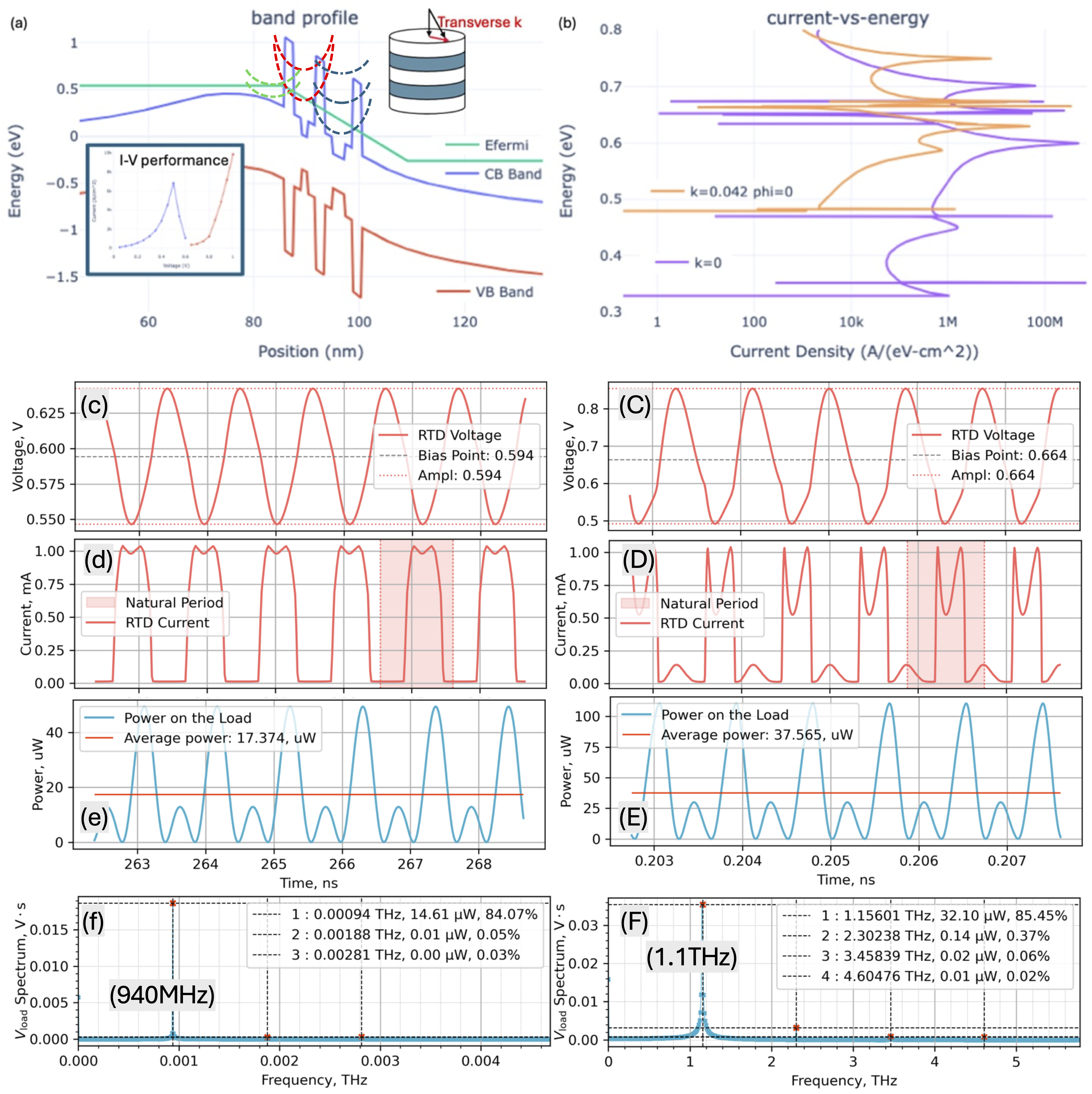
Fig. 1. (a) Band edge diagram. Insert: full I-V. (b) Current density J(E,k) as a function of energy for two different transverse momenta. The spectral features change dramatically with the transverse electron momentum. Left column (c-f), circuit at 1 GHz; right column (C-F) at 1THz. (c) and (C) show the time dependent trace of the RTD voltage which becomes less sinusoidal at high frequency. The voltage swing at 1THz is significantly wider than at 1GHz. (d) and (D) show the corresponding RTD currents. At 1THz the current swing shows significantly complex structure. (e) and (E) show the time dependent power on the circuit load resistance and (f) and (F) the power spectrum at the load
Demand for higher-power THz sources continues to grow across many applications. Resonant tunneling diodes (RTDs) have been studied for THz generation since the early 1990s, and since 1994 the NEGF-based simulation engine NEMO has enabled quantitatively predictive design of InP-based RTDs [1]. Triple-barrier RTDs (TBRTDs) offer added design freedom to increase peak-to-valley ratio (PVR) and improve THz power extraction [2]. Because NEMO captures transport in realistically extended devices with strongly nonparabolic bands and full energy- and momentum-resolved carrier dynamics, it enables a combined strategy: optimize realistic TBRTDs for higher PVR, then use the resulting current-voltage characteristics in time-dependent circuit simulations to identify designs with stronger THz emission.
InGaAs and InAlAs lattice matched to InP, together with strained AlAs and InAs layers, exhibit strongly nonparabolic dispersion, or a strong energy dependence of effective mass. Although RTDs are often described as voltage-dependent electron filters, transport in realistic InGaAs-based structures is more complex and depends strongly on transverse momentum. Quantitative TBRTD design for enhanced THz output must therefore account explicitly for these material and transport effects. Figure 1a shows the prototype TBRTD [2] under high bias, and Figure 1b shows current-density traces versus energy for two transverse momenta. The higher-momentum trace is not a simple shift of the k = 0 trace, demonstrating the need for full Brillouin-zone analysis. The three wells (emitter notch, well 1, and well 2) create interactions among multiple states with different transverse-energy dispersions, producing complex transmission features, including Fano resonances. Circuit simulations in Figure 1(c-f,C-F) further show that operation at 1 GHz and 1 THz leads to markedly different current evolution and voltage swing.
We present design strategies, changes in quantum capacitance and current-voltage behavior caused by internal charge accumulation, and their consequences in fully nonlinear time-dependent circuit simulations. Both the current-voltage response and the resulting circuit behavior depend sensitively on the internal dispersions of the triple-quantum-well system, comprising the emitter well and the heterostructure double well.
References
- R Bowen, G Klimeck, R Lake, W Frensley ang T Moise, J. Appl. Phys. 81, 3207 (1997)
- E Mutlu, A Grygoriev, S Clochiatti, et al., Phys. Status Solidi A. 221, 862 (2023)