

Characterizing Polarization of Nonlinear Thomson Scattering
Invited Talk
J Peatross1, M Ballif1, K Barr1, N Sá2, Y Sun1, M Ware1
1 Physics and Astronomy, Brigham Young University, Provo UT, USA
2 Physics, U. of Azores, Ponta Delgada, Portugal
Seminar: S1 — Modern Trends in Laser Physics
Friday, 10 July 2026 · 13:55 – 14:15
Abstract
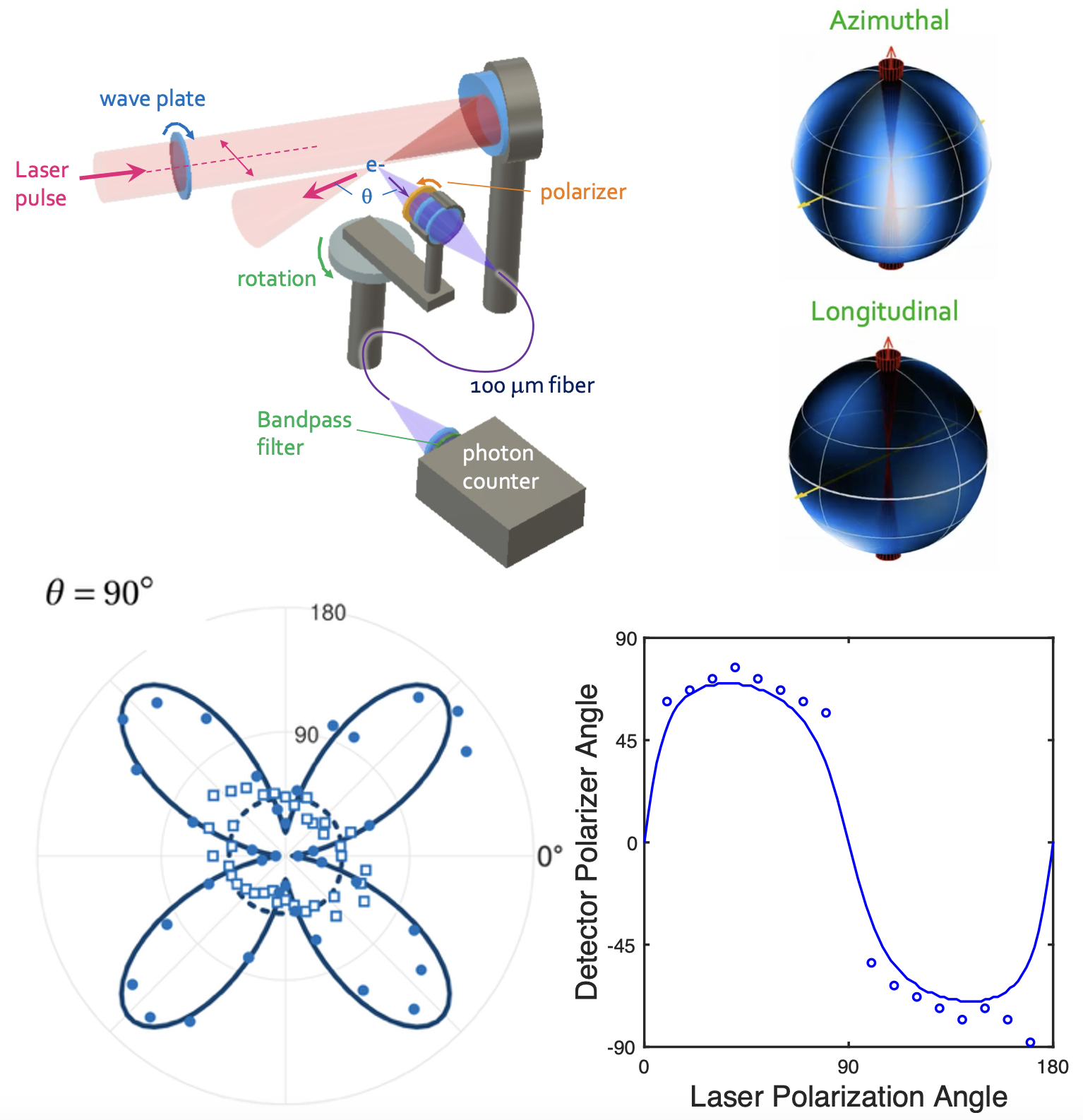
Fig. 1. Experimental setup (upper left), computed far-field 2nd-harmonic emission polarization-resolved along latitude and longitude (upper right) dimensions, measured polarization-resolved 2nd-harmonic emission around equator (lower left), measured polarization angle of combined 2nd-harmonic light (lower right)
We use single-photon counting to characterize nonlinear Thomson scattering from free electrons in an intense laser focus [1]. This includes experimental analysis of the polarization states for the 2nd and 3rd harmonic scattered photons. The setup is shown in the Fig. 1. Electrons are donated from low-density helium, ionized during the rising edge of 800 nm, 40 fs, 50 mJ, 10 Hz laser. Statistics are accumulated from hundreds of laser shots at each measured angle across the full emission sphere.
The peak intensity in the laser focus is $2\times 10^{18}$ W/cm$^2$, which causes electrons to execute the well-known figure-8 trajectory when the laser light is linearly polarized [2]. The relativistic dynamics of the laser-driven free electrons give rise to nonlinear scattering, including the generation of new frequencies. Fig. 1 shows calculated and measured 2nd harmonic scattered photons. Measurements are highlighted around the equator of the emission sphere, oriented such that the laser propagates in the direction of the poles. Electron oscillations along the tall dimension of the figure-8 trajectory produce scattered light with azimuthal polarization (on the emission sphere). Oscillations in the perpendicular dimension produce scattered light with longitudinal polarization. Asymmetry between emission into the `northern’ and `southern’ hemispheres is caused by the fact that an electron moves in the same direction on both ends of the figure-8.
We recently measured the polarization states of the scattered harmonics. Previously, we had measured photons transmitted only through preselected orthogonal dimensions (i.e. azimuthal vs. longitudinal). In this case, the relative phase between the two polarization components remained undetermined. The new measurements demonstrate that the overall polarization of the scattered light is close to linear, in agreement with theoretical predictions. For azimuthal polarization in the 2nd-harmonic angular emission pattern, adjacent lobes are out of phase by 180o, leaving two lobes in phase with, and two lobes out of phase with, the longitudinal polarization. The polarization angle for maximum transmission of the combined light is shown in Fig. 1.
Acknowledgements: This work is supported by the National Science Foundation under grant No. 2207737.
References
- M Romero, L Robins, A Stevens, N Sá, Y Sun, M Ware and J Peatross, Opt. Express 19, 33950 (2024)
- E S Sarachik and G T Schappert, Phys. Rev. D 1, 2738 (1970)