

Certifying Path-Entanglement over Quantum Networks Using Only Quantum Resources
Invited Talk
F Atzori1,2, N Lal3, C M Nunn4,3, M V Jabir3, D Ahn4,3, F Piacentini1, I P Degiovanni1, M Genovese1, I A Burenkov4,3, S V Polyakov5,3
1 Istituto Nazionale di Ricerca Metrologica, Turin, Italy
2 Politecnico di Torino, Turin, Italy
3 National Institute of Standards and Technology, Gaithersburg MD, USA
4 Joint Quantum Institute and University of Maryland, College Park MD, USA
5 Physics, University of Maryland, College Park MD, USA
Seminar: S1 — Modern Trends in Laser Physics
Tuesday, 7 July 2026 · 16:45 – 17:10
Abstract
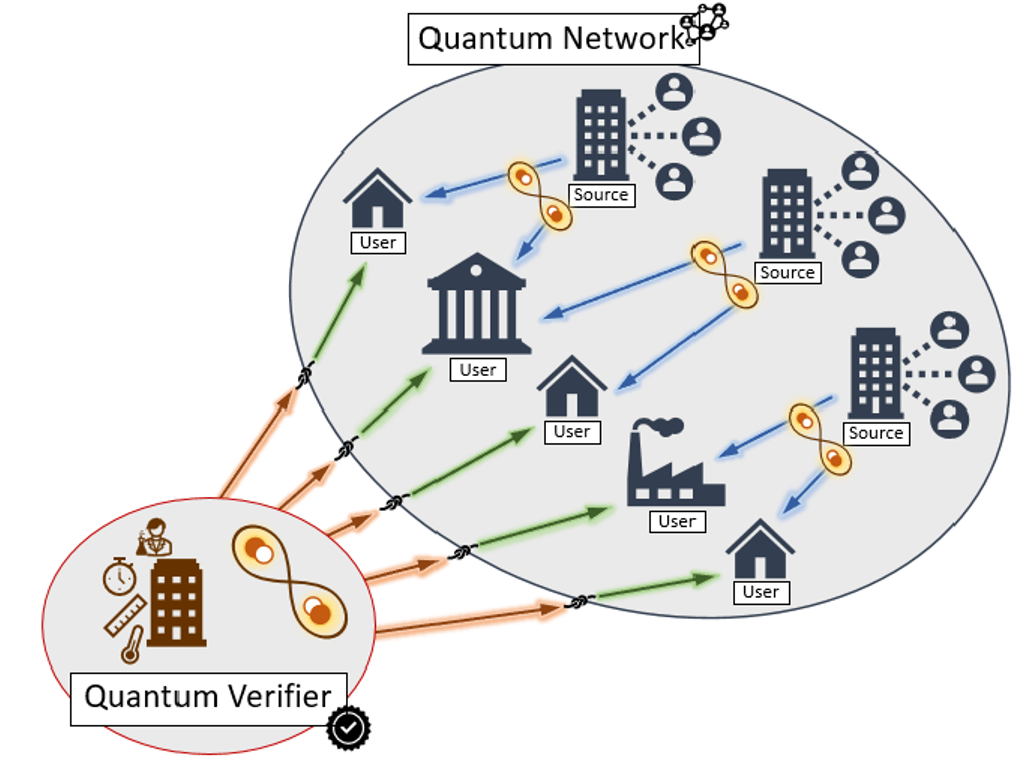
Fig. 1. A trusted quantum verifier distributes path-entangled reference states on a quantum network
The nonlocality of a single photon is a promising resource for entanglement distribution over quantum networks. By simply passing a single photon through an ordinary beamsplitter, “path entanglement” is generated between the two output modes [1]. However, preserving phase information and characterizing this entanglement is quite challenging in a practical network context, typically requiring joint homodyne detection to witness entanglement or for tomographic reconstruction.
Here, we present a method of verifying path entanglement using only quantum resources, i.e., single photons. In this scheme, a trusted verifier node provides a standard reference source of path-entangled photons from a central network hub (see Fig 1). Connected users can then characterize other, unverified entangled states (target states) by interfering them with the verifier's reference states on a space-like separated pair of balanced beam-splitters. In a full-scale, metropolitan-size quantum network, entanglement between multiple pairs of users can be characterized independently with the same resources, effectively substituting the local oscillator from conventional homodyne detection.
We demonstrate this reconstruction method in a proof-of-principle experiment, where verifier and target states are generated independently using a source of highly indistinguishable heralded single photons, based on spontaneous parametric down-conversion (SPDC). The observed interference in a free-space interferometer is used to reconstruct the target state with a complete set of three verifier states. While this demonstration maps path-entangled states onto polarization modes to circumvent the need to stabilize optical phase, we concurrently develop two methods of phase stabilization for future experiments on deployed fiber. Based on time-division [2] and wave-division [3] multiplexing, we successfully stabilize a deployed 120 km fiber link with $\approx$500 background photons per second or fewer in the quantum channel.
References
- S M Tan, D F Walls and M J Collett. Phys. Rev. Lett. 66 252 (1991); DOI: 10.1103/PhysRevLett.66.252
- M V Jabir, D Ahn, N Fajar R Annafianto, et al., Optica 12 570 (2025); DOI: 10.1364/OPTICA.540759
- D Ahn, I A Burenkov, M V Jabir, et al., Optica 13 511 (2026); DOI: 10.1364/OPTICA.586649