

Quantum-Classical Description of Photoionization
Invited Talk
A Husakou1, I Babushkin2
1 Theory Department, Max Born Institute for Nonlinear Optics and Short Pulse Spectroscopy, Berlin, Germany
2 Institut für Quantenoptik, Leibniz Universität Hannover, Hannover, Germany
Seminar: S5 — Nonlinear Optics & Spectroscopy
Thursday, 9 July 2026 · 16:00 – 16:25
Abstract
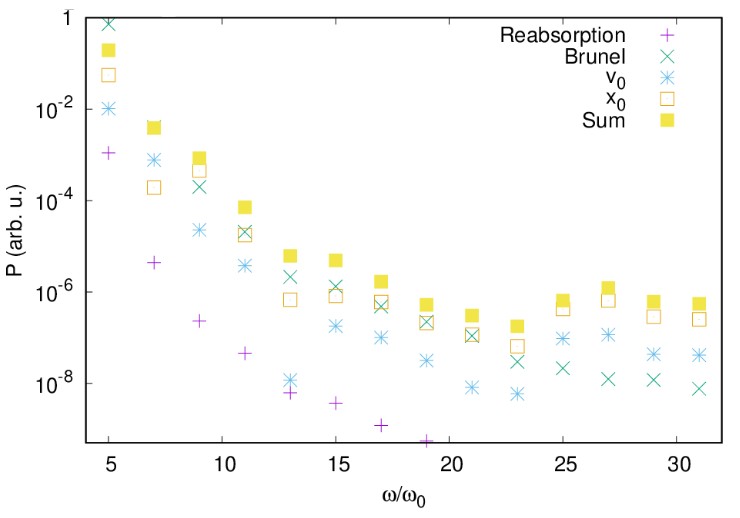
Fig. 1. Relative efficiency of high harmonic generation due to different contributing mechanisms, as indicated in the legend. Pump pulse at 1600 nm with FWHM of 3.6 fs with peak intensity of 0.95x10$^3$ TW/cm$^2$ and pressure of 10 bar is considered
Currently there are two approaches for the description of the strong-field photoionization: The first approach is based on the direct solution of the Schroedinger equation with high accuracy and high numerical effort, and the second approach is based on the analytical expressions for the ionization accompanied by the semiclassical description of the subsequent almost-free electron dynamics.
In this contribution, an attempt is made to find a “middle path” between the two approaches. It consist of solution of the (1+1)D equation for the plane-wave amplitudes for ionized almost-free electrons, as derived directly from Schroedinger equation under assumption that the states of the ionized electrons are almost plane-wave. We derive the generalized expressions for the ionization rate, tunnel exit, and the electron velocity immediately after ionization and separate different contributions to the resulting free-electron polarization.
We predict the emergence of free-electrons both in velocity representation and in space, associated with the maxima of the electric field. However, in contrast to the simple analytical ionization rate, the dynamics is clearly asymmetric around the field maxima, caused by the dependence of the ionization on the previous history of interaction.
While average position and velocity generally follow the expected behavior, the tunnel exit and tunnel exit velocity are strongly time-dependent and asymmetric, with divergences around positions where the ionization rate turns to zero. However, tunnel exit does coincide with the analytical expression around the field maxima, which confirms the validity of the analytical approach in the adiabatic limit.
In Fig. 1 we present the relative efficiency of the harmonic generation due to different mechanisms. One can see that for lower harmonics, the Brunel mechanism plays an important role along with tunnel exit velocity related harmonics. As the frequency increases, the tunnel exit mechanism starts to dominate, accompanied by the tunnel exit velocity related mechanism. This is in contradiction with generally accepted but not rigorously proven assumption that the role of tunnel exit velocity is negligible. In addition, in Fig. 1 we show a contribution of a novel harmonic generation mechanism associated with stepwise decrease of plasma density due to recombination of electron with the ionic core, which is fundamentally different from the Lewenstein mechanism.