

Disorder-Promoted Synchronization and Coherence in Coupled Laser Networks
Invited Talk
A N Montanari1, A E D Barioni1, A E Motter1
1 Physic and Astronomy, Northwestern University, Evanston IL, USA
Seminar: S1 — Modern Trends in Laser Physics
Thursday, 9 July 2026 · 17:05 – 17:25
Abstract
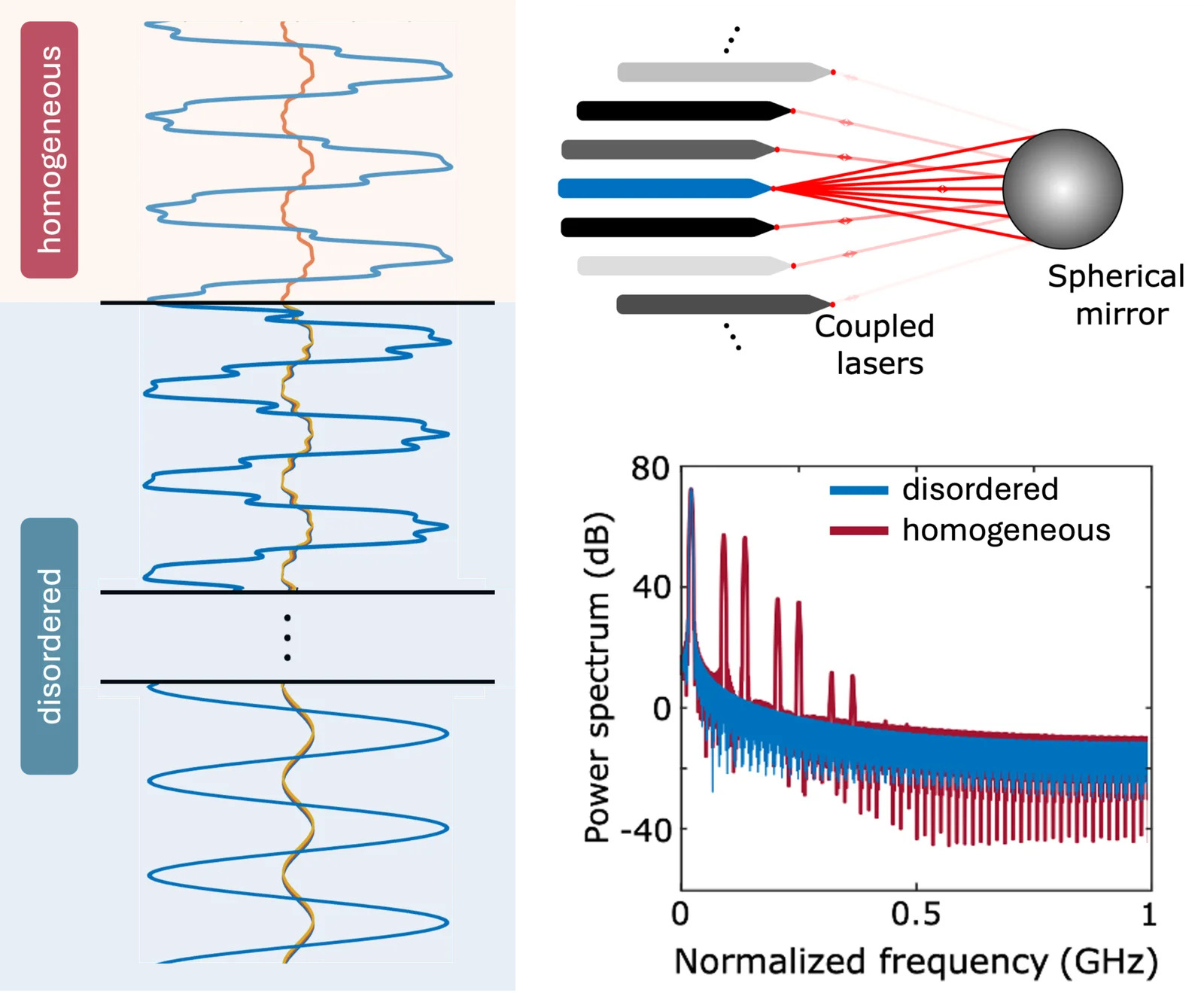
Fig. 1. For a laser array externally coupled through a spherical mirror, we show the time series of the electric fields as the system transitions from a homogeneous to a disordered configuration. In the homogeneous configuration, the lasers synchronize on a limit cycle with zero phase shift but distorted waveforms. In contrast, the disordered configuration produces nearly sinusoidal waves with constant, but negligible, phase shifts among lasers. The small-amplitude signals indicate the imaginary component of the individual fields $E_j$, while the high-amplitude signal represents the combined field $E = \sum_j E_j$. The power spectrum of the combined steady-state field $E$ shows that the disordered configuration attains a narrower linewidth compared to the homogeneous configuration
Coupled lasers offer a promising approach to scaling the power output of photonic devices for applications demanding high frequency precision and beam coherence. However, maintaining coherence among lasers remains a fundamental challenge due to desynchronizing instabilities arising from time delay in the optical coupling. In this talk, we will depart from the conventional notion that disorder is detrimental to synchronization and instead propose an interpretable mechanism through which heterogeneity in the laser parameters can be harnessed to promote synchronization. Our approach allows for stabilization of pre-specified synchronous states that, while abundant, are often unstable in systems of identical lasers. The results show that stable synchronization enabling coherence can be frequently achieved by introducing intermediate levels of random mismatches in any of several laser constructive parameters. This talk will conclude by establishing a principled framework for enhancing synchronization in large laser networks and other coupled oscillator systems.