

QED Cascade in Multiple Radially Polarized Laser Pulse Collision
Invited Talk
M Jirka1, J Vabek1, S V Bulanov2
1 Faculty of Nuclear Sciences and Physical Engineering, Czech Technical University in Prague, Prague, Czech Republic
2 ELI Beamlines Facility, Extreme Light Infrastructure ERIC, Dolní Břežany, Czech Republic
Seminar: S9 — Extreme Light Technologies, Science, and Applications
Tuesday, 7 July 2026 · 16:30 – 17:00
Abstract
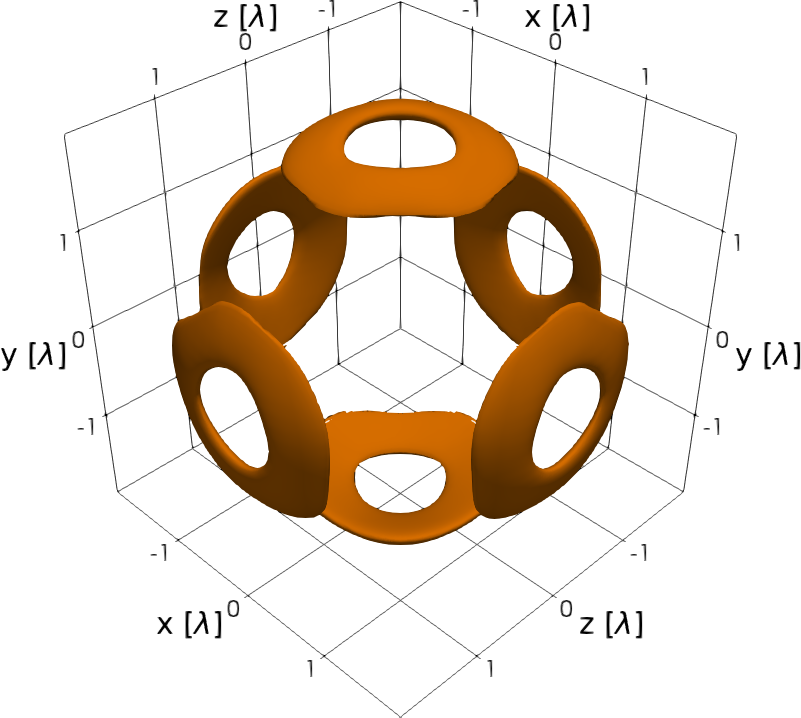
Fig. 1. Interaction configuration of six-beam collision represented by laser intensity iso-surfaces in the simulation box. The seed particles are located in the center of the simulation box
Using 3D simulations, we study electron–positron pair production in a collision of free seed particles with 1, 2 or 3 couples of counter-propagating, short, tightly focused and radially polarized laser pulses (see Figure 1). We found that the delay between colliding couples of laser beams leads to efficient electron–positron pair production. The reason is that radially polarized laser pulses keep interacting particles within the interaction region, and therefore, the pairs created in the collision with the first couple of laser beams can serve as a seed for the consecutive couple of colliding beams. We obtain almost 60 times more positrons created when the total laser energy is divided into three properly delayed couples of colliding laser beams compared to a simple one couple case.