

Subcycle Bandstructure Videography of Electrons Driven by Strong Light Fields
Invited Talk
U Höfer1,2, R Huber2
1 Fachbereich Physik, Philipps-University Marburg, Marburg, Germany
2 Department of Physics and Regensburg Center for Ultrafast Nanoscopy (RUN), University of Regensburg, Regensburg, Germany
Seminar: S2 — Strong Field & Attosecond Physics
Wednesday, 8 July 2026 · 17:00 – 17:30
Abstract
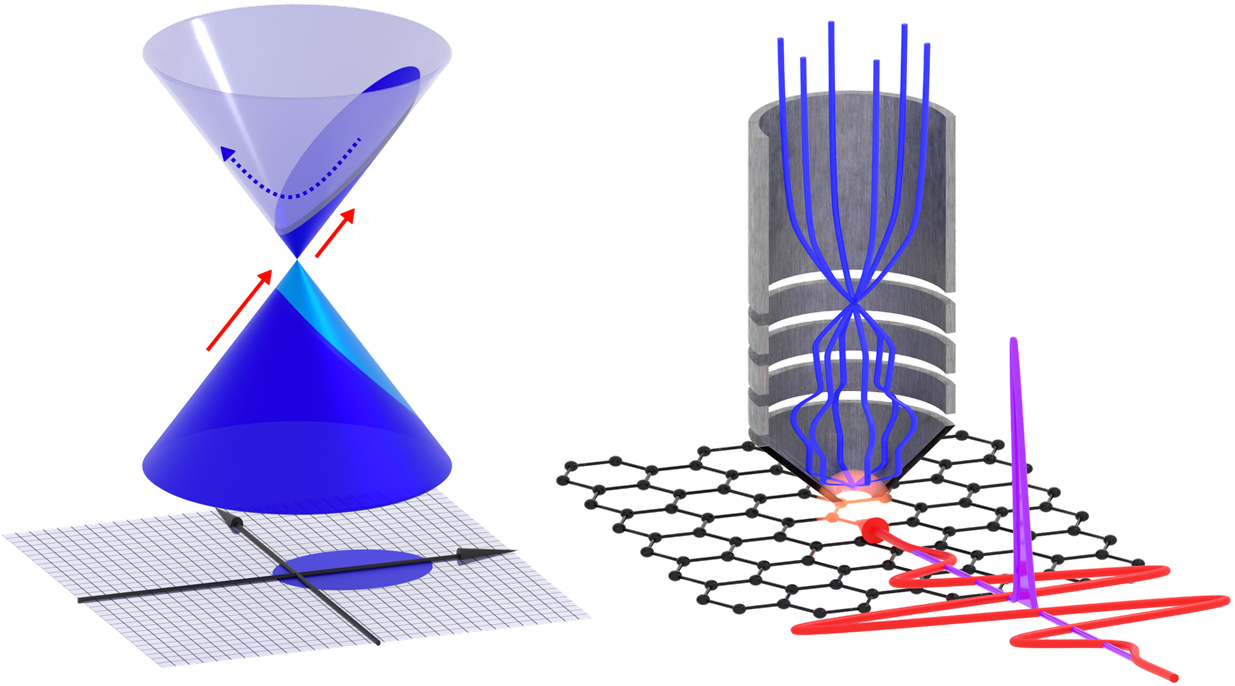
Fig. 1. Strong light-matter interaction in the Dirac cone of graphene. Electrons undergo ballistic acceleration by an electric field (left, dashed blue arrow). Simultaneously, the field leads to LZM tunneling from the valence band to the conduction band (red arrows). Experimentally, the resulting elongated electron distribution which oscillates back and forth with the laser field is detected with a time-of-flight photoemission momentum microscope. This instrument simultaneously records both parallel momenta, $k_x$ and $k_y$, and the kinetic energy for every individual electron
Time-resolved photoemission can combine femto\-second and attosecond pump-probe techniques with angle-resolved photoelectron spectroscopy (ARPES). Recent developments enable the method to access the strong-field regime of light-matter interaction and track electron motion in two-dimensional momentum space with subcycle time resolution. In this talk, I will briefly describe the basic priciples of this novel bandstructure video\-graphy [1] and discuss two examples of our recent work [2,3].
The periodic driving of electrons in the topologically protected Dirac surface state of Bi$_2$Te$_3$ at mid-infrared (MIR) frequencies of 25-40 THz and electric fields in the MV/cm range leads to the formation of Floquet-Bloch bands. Our sub\-cycle ARPES experiments reveal how, starting with strong intraband currents, these Floquet replicas emerge already in the second optical cycle of the driving field and how electrons in high-order sidebands scatter into bulk states [2].
For the investigation of Bi$_2$Te$_3$, a hemispherical photoelectron analyzers in combination with near-UV probe pulses (6 eV) for photoemission is sufficient to image electrons dynamics along specific directions near the Brillouin zone center where the surface state is located. In many other novel quantum materials, however, relevant parts of the band structure are often located at the boundary of the Brillouin zone (BZ). Our next-generation experiment thus combines strong MIR driving fields with sub-10-fs EUV probe pulses (21.7 eV) and state-of-the-art photoemission momentum microscopy [3].
Recent investigation of strong light-matter interaction in graphene illustrate the capabilities of the new setup (Figure 1). The 2D imaging capability of the momentum microscopy and the high time-resolution of the optical setup enabled us to observe an interplay of field-driven acceleration within the Dirac-like band structure and periodic Landau-Zener-Majorana (LZM) interband tunnelling. The effect manifests itself in a coherent displacement and distortion of the momentum distribution at the BZ edge. The created extremely non-thermal electron distributions also puts us in an excellent position to disentangle competing scattering processes and assess their impact on coherent electronic control [3].
References
- J Reimann, S Schlauderer, C P Schmid, et al., Nature 562, 396 (2018)
- S Ito, M Schüler, M Meierhofer, et al., Nature 616, 696 (2023)
- V Eggers, G Inzani, M Meierhofer, et al., arXiv: 2602.12844 (2026)