

Dissipative Soliton Femtosecond 2 μm Oscillator Based on a Double-Clad Tm:ZBLAN Fiber
Invited Talk
N Atikah Azali1, T Fuji1
1 Toyota Technological Institute, Nagoya, Japan
Seminar: S2 — Strong Field & Attosecond Physics
Thursday, 9 July 2026 · 14:00 – 14:30
Abstract
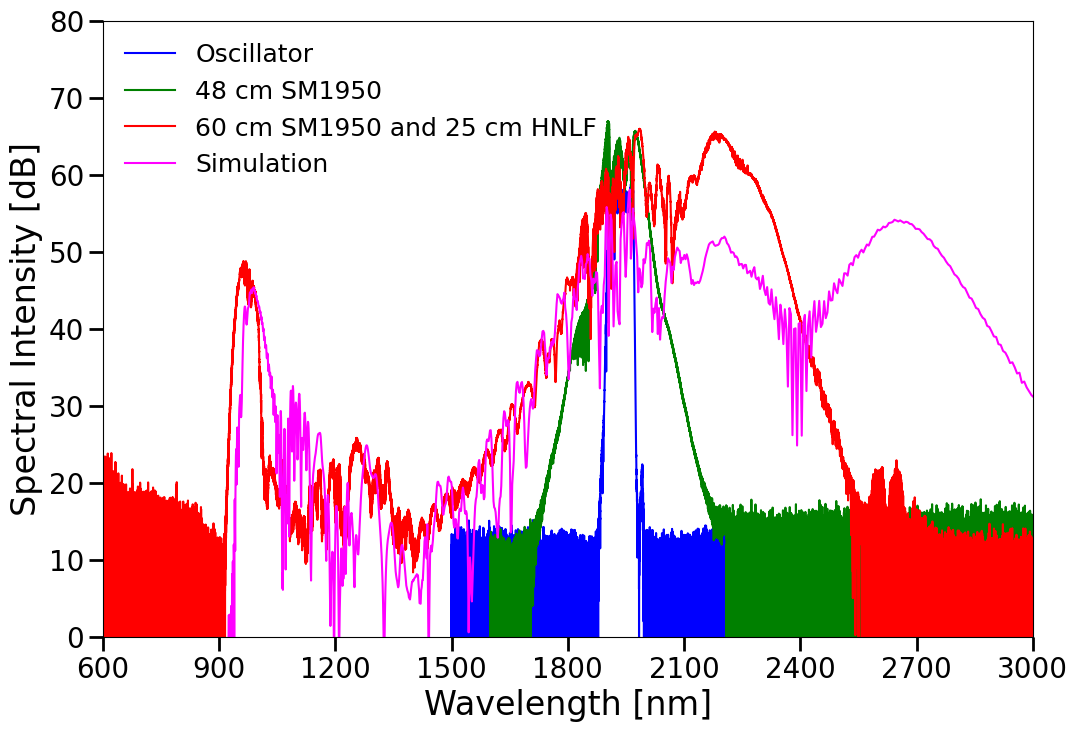
Fig. 1. Power spectra generated from the highly nonlinear fiber (HNLF) (red curve). The spectra of the input pulse (blue curve), the output from the 48 cm SM1950 fiber (green curve), and the corresponding numerical simulation (magenta curve) are also displayed. In the simulation, the absorption of the silica fiber around 3 µm was not taken into account.
We demonstrate a high-energy, 2 µm femtosecond mode-locked oscillator utilizing a double-clad thulium-doped fluoride fiber. The active fiber is pumped by a 790 nm multi-mode semiconductor laser, and stable mode-locked operation is achieved via nonlinear polarization rotation. Because the anomalous dispersion of the fluoride fiber is remarkably small near 2 µm, the net cavity dispersion can easily be made normal by inserting a 3 mm thick Ge plate into the cavity. Consequently, the maximum pulse energy reached 7.8 nJ, representing one of the highest energies reported for a stable femtosecond mode-locked fiber laser oscillator operating around 2 µm. The resulting spectrum exhibits characteristic sharp edge features (often referred to as a "cat ear" or "Batman" shape), confirming that the laser operates in a dissipative-soliton mode-locked regime, which is consistent with the normal net cavity dispersion. Although the direct output pulse duration was 1.3 ps , we successfully obtained 72 fs pulses through nonlinear self-compression within a 48 cm single-mode silica fiber.
Furthermore, we demonstrate the generation of an octave-spanning supercontinuum by launching these pulses into a highly nonlinear fiber. This advancement demonstrates the viability of carrier-envelope phase stabilization for this oscillator.