

A Quantum Mechanical Analysis of the Coherence De Broglie Wavelength
Invited Talk
B S Ham1
1 Dept. of Electrical Engineering and Computer Science, Gwangju Institute of Science and Technology, Gwangju, South Korea
Seminar: S7 — Quantum Information Science
Friday, 10 July 2026 · 14:30 – 15:05
Abstract
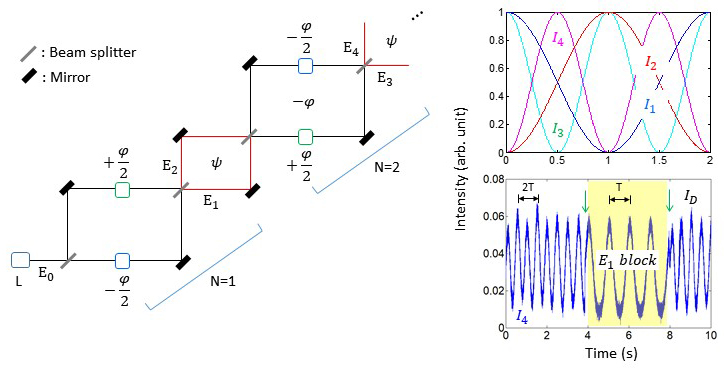
Fig. 1. Demonstration of CBW for PBW-like superresolution. (left) Schematic of CBW. (right) CBW demonstrations in calculation (top) and experiment (bottom)
Quantum sensing has been intensively investigated for decades; however, its practical implementation is constrained by both limited photon number $N$ achievable in N00N states and their extreme sensitivity to photon loss. Because the quantum enhancement scales only as $\sqrt{N}$, the small attainable $N$ represents a serious limitation for N00N-based sensing requiring high optical power, such as ring laser gyroscopes. Conversely, the intrinsic photon-loss sensitivity of N00N states constitutes a fundamental obstacle for remote sensing applications, including LiDAR. Recently, an alternative sensing approach based on coherence de Broglie wavelength (CBW) has been proposed, which mimics the photonic de Broglie wavelength (PBW) associated with N00N states.
In this work, a pure quantum mechanical analysis of CBW is presented and compared with PBW to elucidate their underlying physics. For this purpose, the Fisher information and phase sensitivity associated with CBW are derived within a quantum framework. In addition, a proof-of-principle experiment demonstrating superresolution is performed and directly compared with a PBW-based approach (see Fig. 1). The results reveal that CBW exhibits phase-sensitivity characteristics analogous to those of PBW, with both superresolution and supersensitivity originating from the coherent superposition of cascaded Mach–Zehnder interferometers (MZIs). This mechanism is fundamentally distinct from that of PBW, which arises from $N$-photon correlations within a single MZI. Consequently, the quantum features of CBW are rooted in its wave nature, in contrast to the particle-based intensity correlations of PBW, reflecting two mutually exclusive manifestations in quantum mechanics.
Acknowledgements: This work was supported by MSIT under IITP Grant No. 2026-2021-01810, supervised by the Institute for Information & Communications Technology Planning & Evaluation (IITP).